Showing posts with label flowers. Show all posts

Saturday, 18 May 2013

Garden Flowers for the House

Looking out of the windows this morning and seeing so much colour starting to emerge amongst all the fresh green, it just took my fancy to go out and cut some flowers to bring into the house. I picked up the secateurs ready to wander out to see what might do.
Even before I left the back door, I noticed the rose scented pelargonium cuttings I took last autumn were flowering.


All the tulips look ready to drop petals but there were plenty of other options.


A posy of violas? Certainly appealing.


The starry white flowers of ramsons are very pretty but the smell would probably mean they would be confined to the kitchen. There's a very good reason they are also known as bears' garlic!


This chaenomeles is a lovely colour but I think I should leave them to bear fruit. Even if I don't get around to harvesting them to make jelly in the autumn, the birds will appreciate them in winter. The only time I have seen fieldfares in the garden was during one snowy spell when they came in to eat the fruit left on this shrub.


I'm pleased to have bluebells at all this year. The bitten off leaf to the right of the flowers bears witness to the visit of a family of roe deer just when the leaves of the bluebells and day lilies were starting to emerge. Overnight the plants were grazed to within an inch of their lives but thankfully the deer have been absent for several weeks now so things have recovered and are coming along nicely.


Centaurea is one of those plants which seems to have it all. The leaves, the buds and the flowers are all pretty and they just get on with what they do best with very little work on my part.


This is another such plant. Its name is one of those things which skips capriciously in and out of mind (currently absent, unfortunately) - such dainty and pristine little daisy like flowers with feathery verdigris foliage.
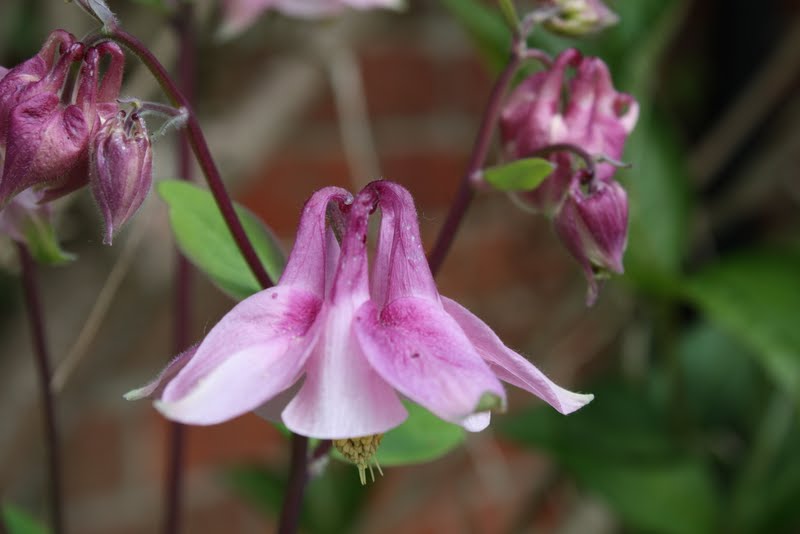

Good old self-seeding, cottage garden granny's bonnets. If you can imagine pink doves, you can see why these flowers are also named columbines after the word 'columba' meaning dove.
 Eventually I picked none of these but I did end up with flowers in a vase on the dining room mantel piece. No delicate posy but a large container filled as a result of some necessary tasks, although I like to think it wasn't entirely devoid of some aesthetic considerations. It certainly has a delicate perfume.


 There is some of the blossom from Our Own apple. I mentioned in a previous post that it leans over the front fence and I accept that not everyone using the footpath outside wishes to be all that intimately acquainted with its charms so I tend to prune back the intruding branches while it is flowering. It is the earliest apple I know of and it has the most fragrant blossom of any of the apples we have in the garden.


The green umbellifer is alexanders. This is a herb I like to have in the garden however that is not to say I am happy to see it everywhere. The first year it flowered I let it get on with it and, as the seed heads ripened,  I admired the ochre yellow stems and black seeds it produced - until the following spring when I found it coming up all over the place. Just like ramsons really - let them set seed at your peril. It's almost enough for each of them to be classified as weeds, I suppose.  I have learned to make sure that both of them have their immature flowers chopped off and sent to the green waste collection which composts at a far higher heat than our own bins do, so ensuring that next spring these two wonderful plants only come back where they are welcome.


Tuesday, 19 February 2013

Snowdrops and sunshine

So you get a day in February with glorious sunshine, no cold wind to speak of and no time commitments. It seems only right to make the most of it and seek out a place for a walk among snowdrops.
For years I had heard of 'The Snowdrop Church' and I knew it is in one of the Meon Valley villages not too far away. After watching last night's weather forecast I did a little looking it up on the 'net. It is the church of Our Lady at Warnford and as the forecasters got it right today, we set out to see how much it earns the title.
As we followed the public footpath across the park towards the church we began to get glimpses of drifts of white and before long the site's reputation was confirmed.
I had read about the Snowdrop Walks held on Sunday afternoons during February. We were pleasantly surprised to find that even on this weekday, the church was open. There is a serenity about ancient rural churches that just begs to be lingered with, breathed in and absorbed.

Evidence of the dedication and contribution of the parishioners
The play of sunlight over a family resting place
The delicate iron tracery in an old flint wall
The walk back through the park and across the river
Such a wonderful way to spend a spring afternoon. And on returning home I noticed something tiny but, for me, very significant nestled amongst the grass and celandines under the apple tree in the front garden.
Our first crocus. Remember how I had said that this event might signify a more auspicious time to set out with new resolve than the first day of the year? I also said the idea of choosing a theme or a word was more appealing than specific resolutions. So I will - I choose the word Exercise. I want to include the obvious physical connotations but go beyond that to exertions of the mind as well and the acquisition of new skills for not only health but that sense of well-being. Where did I see 'Move the Body - Feed the Brain'? That's what I have in mind. And may be with today's walk, I have already made a start.


Tuesday, 5 February 2013

A wintry walk in the forest

Yes the pretty snow has gone for the moment and the winter sun only came out as we rumbled over the last cattle grid and left the forest but much of winter here is about grey and sombre and overcast and muddy so that is what I captured on today's journey through the New Forest.

We had an errand to run in Lymington so I picked up my 'point and shoot' camera as I left the house in the hope that somewhere en route there might be a chance to take pictures. One of my little intentions for 2013 centres on photography and I figure the best way to improve is to do what photographers do and be prepared to take pictures whenever I can. Having a camera to hand keeps the photographer's eye in and there's no regretful thinking afterwards "If only I had a camera.." (There might be other regrets like "If only I had wellies I could have moved to better vantage points.." or "If only I had a hat, my hair would not have been whipping over the lens all the time..." but those are lessons for another day.)

When I first came to the UK from Australia I was under the impression that the term forest denoted woodland and dense plantings of trees. I was unprepared, on my early visits to the New Forest and the Forest of Bere to see open tracts of heathland with scarcely any vegetation taller than a gorse bush. I have since learned that the original term forest is derived from a word denoting land outside the boundaries of settlement - the uncultivated 'no man's land' and is not really a description of the vegetation at all. The fact that many forests did consist of dense woodland led to its use for such places I suppose. Please feel free to correct me on this or expand on it as I am fascinated by the  derivation and meaning of words.


The New Forest has a wide range of habitats and landscapes. Both its natural and human histories are intriguing. Today I confined myself to capturing the atmosphere of a tiny part of it.


Although, I couldn't resist another shot near Beaulieu. I'll call this one the postcard shot - what else could it be with a pony and a thatched cottage?

So nice to see too, on returning home that the sun was highlighting something enchanting right outside my own front door. I just had to pick a handful and bring them indoors.


Thursday, 9 August 2012

Jam Jar Posies

In another career, in what seems like another life, I often received end of year thank you bouquets.Very welcome but no big surprise for a primary school teacher.

There could be several kinds of bouquets ranging from forecourt carnations in cellophane to elaborate florist's arrangements but the ones I found most beguiling were the bunches presented with shy pride, a home-made card and the comment "Nanna said I could pick some flowers for you from her garden."

Typically the flowers would be wrapped in newspaper or cooking foil and would be a brightly coloured miscellany of whatever  is in bloom at the end of July. At the centre would be a rose or a small sunflower surrounded by a spike or two of lavender, a head of geranium or hydrangea, a cluster of daisies or marigolds and a branch of a flowering shrub all gracefully presided over by a nodding raceme of buddleia. A little of everything that had caught the child's eye. I was always so touched by these gifts.

There is such an appealing immediacy, isn't there, in the idea of making something of whatever is close to hand; neither depending on someone else going to the shops nor  restrained by sophisticated notions of style or "what goes together". There was always the confidence that whatever was gathered together would be wonderful and gratefully received. These bunches inevitably stirred happy memories of being allowed to pick flowers as a child.


This idea of  cutting flowers for the house using whatever is in season and informally arranging them in everyday containers, jars and bottles crops up in lifestyle magazines like Country Living and blogs like The Quince Tree. I've always been drawn to these bunches of seasonal garden and hedgerow flowers combined with flowering herbs and grasses.
There'll be other times to bring out the vases I have collected over the years. For now I want to follow the irresistible urge to wander around the garden and gather whatever takes my fancy and display them indoors in simple glass jars. Oh yes, nostalgia is at play here; forget words like "vintage" or "retro", at heart I'm simply an old-fashioned girl.
Some jewel-bright colours for my kitchen windowsill.

Saturday, 31 March 2012

Hapa- zome Part 2 - another bash

There's  possibly only one thing better than pottering about on a warm spring day doing something creative in the garden and that would be sharing it with a like-minded friend.When I showed Sue the initial hapa-zome prints I made for my first post on this craft, she had said she would love to have a go at it. I had been waiting for the garden to produce some suitable flowers to start hammering again.  A couple of days ago with the gorgeous weather,  a growing abundance of blossom and blooms and Sue dropping around for coffee,  it was the perfect opportunity. Different season, different flowers and leaves to try. Here's a sampler of the things we tried.

My hammering technique is a little rusty and not as thorough as it could have been but this is what we found.
Clockwise from top left.
Muscari (grape hyacinth) - very sappy and it is best to strip the little bells from one side of the stem first and lay it with the stripped side uppermost before hammering. Although it doesn't produce a sharply defined outline the blue pigment transfers well and the little bells can be used individually to punctuate or infill other designs.
Forsythia - the colour was a surprise being very more mustard than the bright yellow of the flowers. The four petals made quite a stark cross but I felt they would be worth trying in a formal pattern with other smaller flowers in between.
Perennial wall flower - the flowers are a deep rusty red and produce a dark brown imprint with well defined edges.
Pineapple sage flowers - I love the bright lipstick red of these flowers and they printed as reddish-pink.
Scented Pelargonium flowers - A little bit disappointing but probably worth a more determined try.
Viola - this print shows how lack-lustre my hammering technique has become and somehow the fresh flower excused itself and disappearedfrom the edge of the board in the time between arranging this shot and picking up the camera - something I only noticed after I began reviewing my shots. Check below in this post to see how effective these flowers could be.
Chaenomeles (flowering quince) - very effective prints with good colours and definite edges.
Lesser Celandine -  The colour transfer was good but I was surprised at how blurry the edges were. We tried it again throughout the afternoon with similar results.
Kerria - This is such a messy tousled flower that I would have given it a miss for this technique but Sue tried it and found that it did imprint quite well, including the stem, buds and leaves.
Oxalis leaf - very effective imprints when thorough hammering applied.
Herb Robert leaf - good results, the leaves are such delicate pretty shapes. I think discarding the larger stems is a good idea as it tends to produce a coarser line which detracts from the delicacy of the leaf imprint.

Sue's first try
My first attempts had been made using a length of unbleached calico and I wanted to see how other fabrics would work. A quick trawl through my fabric stash and I found some scraps of poplin and corduroy both of which had been bought so long ago that I could only hazard a guess at their fibre content. I felt they would probably have a high percentage of cotton and so would take the flower pigments reasonably well. The sampler at the top of this post and Sue's first try show how well the poplin worked. Being a finer weave it showed the shapes clearly and being a brighter white the colours were clearer.
As for corduroy - with a viola and methodical hammering, what an effective result!
Viola on corduroy
And Sue showed me with her second try that instead of haphazardly hammering any flower anywhere on the cloth, it might be better to think about an overall arrangement.


Thursday, 22 March 2012

Splashes of gold

We seem to be in the  days of the year when the colour for unfurling petals to be is yellow. The colour seems to dominate every where from the ground up.
The lacquered gold of celandines, creeping in to any corner they haven't been chased out of. I know there are gardeners who deem them to be weeds but they pop up, have their cheery say for a few weeks of otherwise fairly quiet time and  then disappear. I can live with that.

The primroses appear in the garden with more intention on my part. I love this variety Emily, with the pastel yellow of the wild primroses and a splash of deeper gold in the centre. The wild ones are beautiful and quite a common sight on the roadsides and under the hedgerows around here. As yet though, they haven't tried to call our garden home. They would be very welcome.

At the moment, you can't drive very far along the roads without encountering roadside daffodils either in solitary ones or in mass plantings.

And of course, no spring roll call of yellow flowers would be complete without  forsythia.  In some circles it is considered a vulgar shrub and there are gardeners who wouldn't give it ground space.  I can see that clipped into hedges the flowers are dense and intense, brash and brazen. Left to its own natural tendencies it is a much prettier thing; delicate sprinkles of yellow set off well against either a  blue or a grey sky.


Monday, 18 April 2011

April Mornings

It's a great time of the year to go away for a couple of days, if for no other reason than things in the garden are changing so quickly and there is so much to see when you get back.
 The cherry blossom is drifting off the branches and scattering over the lawn; one spring feature is over but there are other delights queuing to take its place.
 A  rich mauve auricula which has its place in my 'garden jewelry box' - an old ceramic sink we found in the garden. This plant is tough enough to survive along with some little cyclamen and primroses with the barest minimum of watering and weeding.

 Freckle Face violets which combine two childhood memories.  Violets were the first flower  I asked for garden space to grow and had  success with. The second  memory is dipping an old toothbrush in paint and then rubbing a thumb across it  to make spatter patterns and stencils.

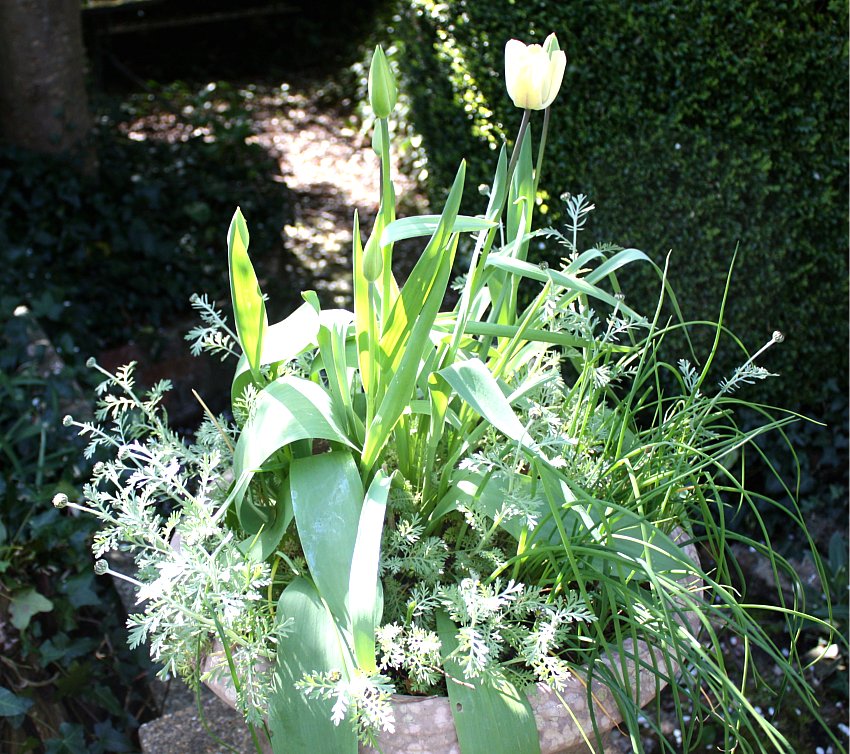
A tub of tulips that this year have managed to evade the jaws of the local population of roe deer. This time last year absolutely all the buds were well on the way to becoming venison. I have planted some chives in the tub now, partly so that their purple flowers will complement the fringing on the Shirley tulips but mainly so that every time I pass, I can crush a few of the leaves in the hope that the onion odour will put the deer off the whole tub. May be it has worked, may be they have just found better fodder in the neighbours' gardens; I'll let you be the judge.
And then proving that the snowdrops and daffodils were merely the opening rounds of the bulb season, the beautiful scilla, hanging on to the dew.


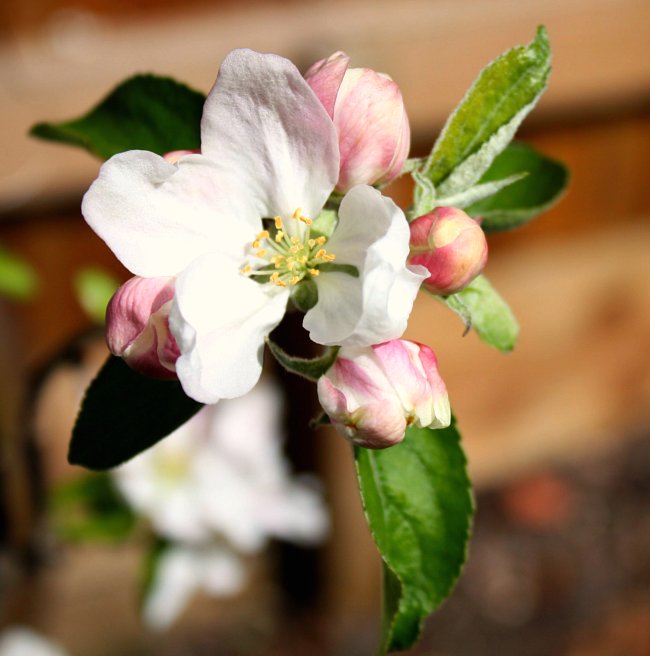
 The fruit blossom is far from over as the crab apple shows.

 The beautiful fondant colours of apple blossom with their wonderful scent.
A garden  with so much to be grateful for in spite of the weeds and the work. Sometimes the real gems of this patch take some seeking out, like the bluebells that appear each year in one of the wilder places, enough to remind me that it is time to gather up my camera and head for the woods.

Sunday, 27 March 2011

Days of Daffodils

There's no ignoring them! The sunny days we have had lately could have been made for them. They are everywhere; in clumps, drifts and even modest singles, all reminding us how well Wordsworth captured the impression they give. 'Jocund company' undoubtedly.

We found these in the garden under an old apple tree, one of the pleasures of our first spring living here. With their fresh  colour combination of palest yellow and clear gold and an elegant twist to each petal and even the leaves, I have been delighted to see them each year since. I have planted other daffodils in the garden, but I think the only others I like almost as well as these are the Tete-a-Tete which are almost over now, having picked up the baton from the snowdrops.

The choice now is to decide  whether to enjoy them in the garden or to bring their cheer inside and have vases of them throughout the house. With some special care when bringing them indoors,  the toxic effect that the sap from their stems has on other flowers and leaves can be minimised.

Meanwhile it seems just the right time to let the daffodil effect creep into my knitting.

Saturday, 5 February 2011

Flower Worship

Now that the snow here has melted and the first flowers of the year emerge, it is time for galanthophiles to wrap up warmly and set out on snowdrop walks. I love to see these delicate reminders of the suggestion that even while the bleakness, the dark and the cold are still with us, there is hope that there will also be flowers and blossom soon to follow. I have treasured the few snowdrops we inherited with the garden and have been delighted to see them spread to become a carpet beside the footpath. I don't rank myself among the truly or obsessively devoted to these pristine little flowers as I have never intentionally planted them or sought to collect new varieties or even set out  especially to walk amongst them in the several well-known locations around here. But every year I find myself wondering what it is that inspires a passion far greater than my affection. What is it about any flower that invokes this great love? There are societies whose members devote themselves to the propagation of orchids, fuchsias and so many others. There are those inspired by their passion to raise and maintain national collections. What is it about human nature and human senses that such specific colour and form can inspire such devotion of time, effort and resources to the extent that it necessarily excludes most other plants?

I may have come close to finding out when I encountered the Sacred Lotus. In the Botanic Gardens in Adelaide you can round a bend in the path and glance across to see a sight which can stop you in your tracks. It can send any thoughts you had of seeing the whole garden in a morning, or  friends waiting to meet you for coffee at the kiosk, or the guided tour you thought you might join, far from your mind.
 So you catch your breath and stand stock still for a moment and then give in to the urge to draw closer. The soft green leaves are waist high obscuring the pond; only the sounds of moorhens and wood duck  happily splashing about under their cover hint at the presence of the water. The flowers are at eye level opening from a neatly furled pink bud to the open flower fading to cream. Then the petals drop to reveal the conical seed head shaped just like the spray head of a watering can. Leaves, buds, flowers, seed heads are all instantly recognisable as motifs used in Eastern and Egyptian art.
In my case it took sometime for this visual impact to wane enough for me to remember that I had a camera and like other visitors could try to capture the beauty of these plants. 

I also began to listen to the conversation between a guide and the gardener tasked with the job of wading waist deep into the pond to pick some of the flowers. Parts of the plant are sources of food and medicine in other cultures. Scientists working with this particular planting have found that the plant has the ability almost unknown in the plant kingdom to regulate its temperature. It also features in the symbolism of several religions. Stunning, remarkable and an instance of that overworked word, iconic.
I still have no rational explanation of what drives some people to become enthusiasts, devotees, obsessives or just fans of a particular flower but I think I have an inkling of the feelings  that fire such inspiration.