Showing posts with label seasons. Show all posts

Saturday, 8 June 2013

The Daisy Chain Approach to Getting Things Done


I'm not greatly given to compiling To-Do lists, even though I know that ticking off the achieved tasks can be so gratifying. What happens to all those little things that need to be done but hardly warrant a place on a list? If I zealously write all of them down, the list becomes quite daunting, if not completely overwhelming. I find a less regimented approach works better for me - well, most of the time it does.
Each day has its priorities due to habit, occasion or the acceptance that procrastination has gone on for way too long. I suppose those priorities would be the backbone of a To-Do list if I was making one and then there are other things that I hope to fit in as opportunities arise. How does the list-free daisy chain work?

Imagine this:

Having established that the rest of the house is in order, you head into the kitchen. It is rather early to be making lunch but you know that there are lots of things that would make it all run much more smoothly later on, so you empty the dishwasher and clear all the work surfaces.
You notice that a banana peel has been set aside from breakfast. You know that snipping it to shreds and scattering under a rose bush is such a good idea because in the few years since you have been doing this, the roses have never flowered so abundantly. It is such a little job that won't take long.
 As you are scattering the shreds, you remember seeing some rather pernicious weeds around another rose and if you were to whip those out right now they could be put in the garden waste which is being collected today.
On your way back from the waste sack by  front gate you notice that there is enough rhubarb to harvest. The leaves can go in the compost bin so you track up the back garden to do that.
You notice on the way that the box bushes are overdue their annual 'haircut'. It has been  left until later this year waiting for the chance of an overnight frost to be past. Just then you notice a blackbird with a beakful of potential baby chick food. You have suspected they are nesting in the garden and you settle down to watch where the bird is heading as it may mean that an occupied box bush will have to wait until the baby birds have fledged before being trimmed. It takes a few food runs to establish which bush it is as the parent doesn't fly straight to the nest but cunningly diverts through other shrubs.

You then notice that some tulips in a tub should be dead-headed and that the tub is rather dry - in fact all the outdoor pots and tubs need water on what is set to be a warm sunny day. Several watering can runs later you then think that the cuttings that have been sheltering on the conservatory window sill could be outdoors now so you go to bring them out.

You look up and notice the clock on the conservatory wall seems to be very fast. Now that really will need adjusting as you rely on that when you are pottering about outside. Just then a voice at your elbow says "Ahem. You haven't forgotten that we have someone coming to lunch, have you? You know he will be right on time." (Oh, so that really is the time!)
"Of course not." Your voice trails over your shoulder as you try to make a hasty sprint to the kitchen look like a nonchalant stroll.

So what is really going on here? A butterfly brain at play, displacement behaviour or serial distraction? In this instance it was probably nothing more complicated than finding excuses reasons for staying in the garden on the warmest day of the year so far. Drawn as a diagram would it be a mind map or a flow chart? I like to think of it as a daisy chain.
And yes, lunch worked out just fine with everything on the table on time.

Monday, 22 April 2013

The Arrival of Spring - 2013

Last year spring arrived early and I had decided to use April 22nd, Earth Day and the anniversary of my grandmother's birth to record how things were coming along in the garden. I wasn't all that sure that doing this year on year would prove to be very interesting but at least I would have a record of what an early spring looked like in our garden. How wrong I was! This year's very cold and gloomy March and early April has made a significant difference. Last night as I was looking through last year's shots to see what to photograph today, I had a feeling there would be rather a lot of bare twig photography. This is what I found.
The 'Freckle Face' violets that were flowering so well have only just managed the first bud - on the upper right, in case you have missed it.
The plum blossom was finished this time last year but up until about ten days ago the branches were quite bare and now there are just the beginnings of buds.
That's more than can be said for the apple trees. No glorious blossom, just a few green shoots and a lot of brown fence to see here.
The auricula has buds - closely bunched down there at the base of the leaves.
The clematis still has flowers with little sign yet of the silky seed tassels.
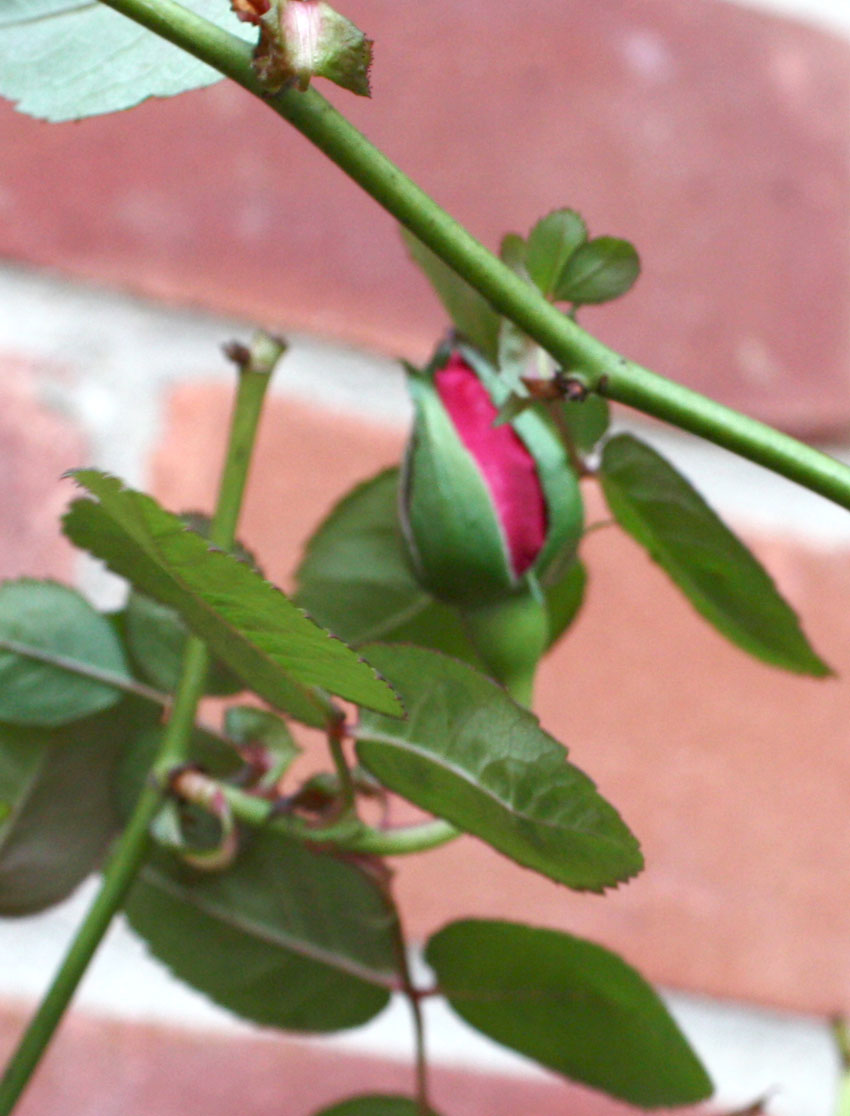
Not even the babiest of rose buds! Some of the first foliage to break through was frost bitten by the March snow, so understandably it has been held back.
The rhubarb is only just pushing up out of the soil. Admittedly I have seen rhubarb in other people's gardens which is more advanced than ours - no idea why. Perhaps it is the variety.
About the only thing that is at pretty much the same stage as it was this time last year is the little wild violet.
But lifting my spirits are the cowslips I planted last year. So pretty, I hope they make themselves well and truly at home here.
No matter how cold and gloomy winter has been, there always comes that day when you step outside to work in the garden and you realise you won't really need a fleecy jacket. The sky is clear and the still bare branches make soft vein shadows on the grass. The breeze is just enough to make the yellow and white flowers shimmer. Your eye is caught by the gently erratic flight of brimstone wings and you try to identify the bird song around you as you work. Then from the distant wood comes a call that makes you stop and strain to hear it again. Is that the first cuckoo?
The wonders of that day are  so very welcome no matter what date the calendar shows.


Tuesday, 5 February 2013

A wintry walk in the forest

Yes the pretty snow has gone for the moment and the winter sun only came out as we rumbled over the last cattle grid and left the forest but much of winter here is about grey and sombre and overcast and muddy so that is what I captured on today's journey through the New Forest.

We had an errand to run in Lymington so I picked up my 'point and shoot' camera as I left the house in the hope that somewhere en route there might be a chance to take pictures. One of my little intentions for 2013 centres on photography and I figure the best way to improve is to do what photographers do and be prepared to take pictures whenever I can. Having a camera to hand keeps the photographer's eye in and there's no regretful thinking afterwards "If only I had a camera.." (There might be other regrets like "If only I had wellies I could have moved to better vantage points.." or "If only I had a hat, my hair would not have been whipping over the lens all the time..." but those are lessons for another day.)

When I first came to the UK from Australia I was under the impression that the term forest denoted woodland and dense plantings of trees. I was unprepared, on my early visits to the New Forest and the Forest of Bere to see open tracts of heathland with scarcely any vegetation taller than a gorse bush. I have since learned that the original term forest is derived from a word denoting land outside the boundaries of settlement - the uncultivated 'no man's land' and is not really a description of the vegetation at all. The fact that many forests did consist of dense woodland led to its use for such places I suppose. Please feel free to correct me on this or expand on it as I am fascinated by the  derivation and meaning of words.


The New Forest has a wide range of habitats and landscapes. Both its natural and human histories are intriguing. Today I confined myself to capturing the atmosphere of a tiny part of it.


Although, I couldn't resist another shot near Beaulieu. I'll call this one the postcard shot - what else could it be with a pony and a thatched cottage?

So nice to see too, on returning home that the sun was highlighting something enchanting right outside my own front door. I just had to pick a handful and bring them indoors.


Sunday, 30 December 2012

Little Intentions for the new year.

The end of one year and beginning of another. What better time to reflect on what things in life are over and best consigned to the past, what things are at their best right now and what is yet to come.
I know it is the custom to draw up a list of New Year's resolutions but I know too that it takes more than hanging up a new calendar to inspire me to make changes in my life. I just don't think it is the right time of year. For a start too many of these resolutions are a rueful attempt to correct the excesses and indulgence of the last month or so, perhaps it would be better to draw up a list and file it to be considered next October or November. And here in the UK with the short days and cold, gloomy weather it is no time for any kind of self-reproach or resolving to do anything which entails going outdoors. Far better to leave all that for a few weeks, perhaps until the first crocus appears when Mother Nature is burgeoning with  renewal and the atmosphere breathes optimism and self-belief.
Perhaps you are one of those who choose a word to be a focus for the year or to epitomise a theme to inspire them. I find this is far more appealing. I may well do that for 2013. But I also like to take time to think about all the times I have started sentences with "One of these days....." and think about the actions and activities that have followed on. I don't mean the ones that have "I should", "I had better" or "I really ought to" - I only have to open almost any cupboard in the house to be reminded of at least one of those. And I'm not saying that life wouldn't be better if I didn't get stuck in and achieve them all. It's just that I feel that now is a good time to plan something interesting, enjoyable, fun even, so I want to think of all the times I have said "One of these days I'd really like to..."  and choose some of those for the year ahead. For me, in 2013, I am not looking for grand bucket list items that involve being somewhere or with someone or on a day in particular, I already have a notebook with some of those in. I just want some things I can largely do here at home, by myself, when I can.

So here it is, my list of 'little intentions' for 2013.
  • Make sour dough bread
  • Knit a pair of socks with properly turned heels and grafted toes
  • Handcraft a book
  • Complete a 30 day photo challenge
 Yes, I will no doubt be baking, knitting, crafting and taking photos anyway but each of these intentions represents something I haven't tried before. And for none of them will there come the day when I leap from my bed (oh, for the chance!) and achieve it before sundown. There will be preparation, a revisiting of existing skills and knowledge, reseach, learning and practice so each of them presents a journey. Maybe none of them will be my greatest achievement for the year but it is time they were no longer consigned to that indefinite time frame "one of these days."

Working on the principle if you want to learn about something, read a book, I gathered up the books I could find in the house that might prove most useful. I can see trips to the library are in order and recourse to the internet.
"When the pupil is ready, the teacher appears." 

So right, I am ready to be pointed in the right direction(s). If you know of any brillant books or websites that would help, I would love you to list them in Comments.

What would be your Little Intentions for the year ahead?

Wednesday, 21 November 2012

The last of the turning colour

It was late today by the time the forecast clear skies appeared. The sun was low and the colours seemed to have been leached by days of leaden clouds, wind and rain. Well, beggars can't be choosers, I told myself  as I tugged on wellies and picked up the camera.
The oak that frames our view of the field behind the house has turned dull brown, as usual the last and least vibrant of autumn colours but against the sky and the shadows across the recently turned earth of the field there is the pleasing subtlety of a Ravilious print.
Subtle too, the darker tones seemingly airbrushed onto the fading wiegela leaves.
Some brighter colour from the wild rose hips and beech leaves still clinging to the branches.
And finally a promise. What is that saying about gardening being an expression of faith in the future? At last I was able to plant out some Pheasant's Eye narcissus.
With a name like Poeticus Recurvus and the promise of fragrance they have to be something to look forward to don't they?


Sunday, 21 October 2012

Seasonal Soup

Almost any hot soup would be welcome as the days grow colder and greyer but with the preparation for Halloween and bonfire night in full swing then Pumpkin Soup seems to be the soup of the day.
And it is here that I have to confess that the soup that my family and friends have been sipping for years as Pumpkin Soup has not actually had pumpkin in it, rather the principal ingredient has been squash, either butternut or the lovely silver grey Crown Prince when I can find it in the shops. I find the flavour, colour and texture of those squashes much richer than any vegetable sold as pumpkin here. As for the recipe, I always seem to need to have the NMAA Cooks - Recipes for Busy Mothers open at recipe 213 to make this soup.

It is one of those pages whose ripples and splash marks bear testimony to a much-made recipe and pencil notes in the margin reflect the fact that the making of it is evolving. Quite why I need the book open at that page is a mystery to me now, I seem to have diverged from the original. It reminds me of the anecdote about the family who pleaded with one member to reveal the recipe for a much loved cake. Eventually at a family gathering the aunt whose specialty this cake was, produced a fragile, yellowed and obviously aged newspaper cutting. The bickering over who should have first chance to copy the recipe was stopped when the aunt said " Well yes, that's the recipe, but it is not how I make it."
So it is with my soup recipe. I seem to need the original to hand to remind me how I have adjusted it over the years.

Autumn Squash Soup
 Ingredients:
  • 500g prepared butternut squash, peeled, de-seeded and chopped
  • one leek
  • 2 cloves garlic
  • 40g butter 
  • half teaspoon ground cloves
  • tabasco sauce
  • 250 ml vegetable or chicken stock
  • 400 ml milk.
  • Juice of half a lemon
 You need to:
  1.  In a large saucepan melt the butter gently.
  2. Wash and slice the leek, crush the garlic and add to the butter. Stir for a couple of minutes then add the prepared squash. Stir well then pop the lid on the pan and let the vegetables, sweat in the butter to soften for five  minutes. 
  3. Add the cloves and some drops of Tabasco sauce, along with salt and pepper.
  4. Add the stock. It could be made with a stock cube or as I often do, bouillon powder but it would also be a good way to use any good chicken or vegetable stock you may have to hand. Stir and cover again, then let it simmer gently until the vegetables are soft. Should the pan start to dry out, you can top up with some of the milk.
  5. Once the squash is soft, puree the mixture. It just so happens I have a liquidiser and use it as it gives the smoothest results but any blitzing gadget or even a sieve would be fine for this.
  6. You should now have a pretty thick puree, so rinse the pan and pour the soup back in. You will now adjust the thickness and seasoning. 
  7.  Gradually add milk and stir gently over a low heat until you have the thickness you prefer. 
  8. Add the juice of half a lemon. Taste and adjust the seasoning and 'heat' adding more Tabasco to taste.
  9. Serve garnished with whatever appeals; a swirl of creme fraiche, finely chopped chilli or coriander, croutons, perhaps.
This soup is just as good being sipped around the dinner table or served in mugs around a bonfire. There is also something, maybe in the cloves, the garlic or the Tabasco that has a somewhat restoring quality, useful when that tickle in the throat hints that you may be succumbing to a winter virus. 


Wednesday, 12 September 2012

Apple Cake, anyone?

Our apple crop is far from spectacular this year, so we will just have to make the most of those few we do have. No frozen juice or gleaming jars of chutney this year. I began collecting apple recipes ever since our first autumn here when I realised our four trees would present us with a harvest far beyond the scope of the tabletop fruit bowl. Some English counties seem to each have their own apple cake recipe but so far a Hampshire recipe has not come my way so I am going to presume the title for my cake, as it was made in Hampshire from apples which, so far as I know, may well be unique to this county. (see below)

Hampshire Apple Cake.
You will need:
  • About 250g of dessert apples
  • 125g unsalted butter
  • 150g caster sugar (plus extra for the topping)
  • 1 teaspoon vanilla extract
  • 1 lemon
  • 3 medium eggs
  • 1 rounded teaspoon baking powder
  • 3 tablespoons milk
  • ground cinnamon
(Please note that if, like me, you use the ingredients shot as a visual larder checklist that the lemon, baking powder, and milk are not included in this shot!)

Tin Size: 23cm     Oven Temperature: 180C, gas mark 4.

What you need to do:
  1. Preheat the oven.
  2. Prepare the tin and plan the cake's escape route. Cakes with a baked on topping are best lifted out of the tin rather than turned out. Either use a spring-form tin or else put a band of folded baking parchment across the base leaving long enough ends to be able to lift the cake out. Either way grease the tin and dust lightly with plain flour.
  3. Zest and juice the lemon.
  4. Cream the butter and the 150g castor sugar. Add the vanilla and lemon zest.
  5. Reserve about half of one of the egg whites in a dish at this stage, and beat in the rest of the eggs.
  6. Sift the flour and baking powder together and fold into the mixture. Then add the milk. Mix completely and set aside for ten minutes while you attend to the topping.
  7. Peel, core and slice the apples. Sprinkle with a little lemon juice to stop browning and set aside.
  8. Lightly whisk the reserved egg white. 
  9. On a plate, mix together approx 50g caster sugar and 2 teaspoons cinnamon. I also add a little extra vanilla kick here with some powdered vanilla I found in an Asian supermarket but it is not essential.
  10. Spoon the batter into the prepared tin. Then dunk the apple slices in the egg white, then in the spiced sugar and arrange them overlapping on the top of the cake. The egg white helps the sugar stick to the apple and adds a little crispness to the topping.
  11. Bake on the middle shelf for 50-60 minutes, until firm to the touch. Allow to cool for 5 minutes before lifting it out of the tin to cool on a rack.
Anyone who has been in a kitchen where apples are being cooked with cinnamon will know the smell is wonderful; layer in the elements of vanilla and lemon zest and it becomes heavenly. If you are  making this for guests, bake it just before they arrive. It would almost be mean, wouldn't it,  not to share the full olfactory experience and like most apple cakes it is so good served warm. Should you feel that some dairy unctuousness would not go amiss then by all means slip some creme fraiche or vanilla ice-cream on the side.

This is a good accompaniment to tea or coffee. It gives a good cake to fruit ratio. It is not however, one of those currently fashionable high-rise multilayer cakes, so tall that "if you slice me, I will have to lie down on the plate" but, to my mind, that is not necessarily a bad thing.
As for the apples I have used, we call them Our Own apples, not that the fruit from the Katy, James Grieves and Cox's Orange Pippin trees in our back garden has been scrumped, you understand; we simply haven't been able to work out just what variety they are. The tree was well established here when we moved in, leaning companionably over the front fence. Since there had been an apple orchard on the land across the road it could well be  a seedling. It has a pretty, flecked reddish skin with a fine russet overlay. The flesh is firm, white and juicy with a deliciously distinctive flavour. It is very early, usually ready to drop from the tree during the third week of August and like most early apples doesn't keep for very long. They make the most refreshing juice and most people who have tasted them are very enthusiastic. A great accompaniment to cheese.
Trying to work out just what they might be, I have gone to various Apple Day events but have tasted none quite like these. I started with Blackmoor Open Day. Later I tried the Apple Affair event at West Dean and then visited Brogdale Hall and RHS Wisley. All of them are well worth a visit if you are considering growing apples or even if you simply like eating them - lots of great advice and fantastic tasting opportunities and recipes. The apple identifying experts I asked suggested either Ross Non-pareil  but that is a later variety, or St Edmund's Russet which comes closest but the flavour isn't quite the same. Perhaps it has St Edmund's Russet in its parentage.
Not knowing what I would replace the tree with should disaster strike, I decided that propagating 'an heir and a spare' might be a good idea. I don't have the grafting skills for this but in early 2000 I found someone who did, Mr House at Family Trees Nursery. I  took him some pencil-thick wood and he grafted two onto dwarf root stocks which are now well on their way to being good producers - weather and my rather suspect pruning skills permitting.
So my visits didn't come up with a convincing answer but I am grateful for the quest.  I would thoroughly recommend going to any of the heritage orchards and places I have mentioned and checking out local Apple Day events. Consider growing something you will never find in a supermarket. Having the chance to pick and eat even a few apples from your own tub-grown tree is enough to bring out the Eve in all of us. 
I have reined in my quest to know just exactly what they are now; in truth I would rather think that they are indeed simply Our Own.


Sunday, 22 April 2012

A Movable Feast - the arrival of spring

'Freckle Face' violets
So much talk this year of how early spring has arrived. Is climate change responsible for the emergence of some spring flowers earlier and earlier each year? I decided it might be a good idea to keep my own record, to set aside a particular day of the year on which take photographs of various plants in the garden to keep track of where they were in their journey from bursting into leaf and bud to 'going over'. After being annoyed with myself for having this interesting idea well after the spring equinox, I decided that I would settle for April 22nd, the anniversary of my grandmother's birth (130 years. this year). A great way to celebrate the memory of a remarkable gardener who most certainly contributed to my fascination with growing plants.On opening Google I was amused to see that it is also the day designated by the United Nations as International Mother Earth Day. Entirely fitting.

It proved to be an interesting challenge. I usually take a camera stroll round the garden looking for what would make interesting/attractive shots. This time, as well as capturing plants at the height of their petal power, I wanted to also record those which had gone past that point or were yet to get there even though these may be far from eye-catching. My hope is that they may prove more interesting when compared year by year with their future selves. Never-the less there were some wonderful flowers and emerging plants.
Lots of buds on this vibrantly mauve auricula. The chewed leaf is testimony that with lots of new tender foliage about, the creatures that like to feast on it are emerging also.
The plum blossom is past its frothy white best,
but the apple blossom is just beginning to hit its glorious, delicately scented peak.
It's not all about flowers. Planted in 2010, this rhubarb will yield a few stems for the kitchen this year.
Silky tassels of seed heads have replaced the creamy green flowers of the clematis 'Wisley Cream'.
Only one rosebud about to break into colour.
But surely April is about violets, both the cultivated ones (see above) and the wild ones. I can't decide which I am happiest to see.
Now for those of you who may like their internet browsing to be a little more interactive, you could try to see how many of the weeds that flourish on Hampshire clay soil you can spot in the background. (Had I posted my unedited shots, I would say that unless you had spotted 80% of them you weren't even trying!) I am trying to be particularly vigilant about bindweed this year - as I have been for each of the thirty or so years we have lived here.

So to you Grandma, a toast. May your resilience, resourcefulness and quiet determination to make the best of things be part of what you have passed on to me.


Thursday, 22 March 2012

Splashes of gold

We seem to be in the  days of the year when the colour for unfurling petals to be is yellow. The colour seems to dominate every where from the ground up.
The lacquered gold of celandines, creeping in to any corner they haven't been chased out of. I know there are gardeners who deem them to be weeds but they pop up, have their cheery say for a few weeks of otherwise fairly quiet time and  then disappear. I can live with that.

The primroses appear in the garden with more intention on my part. I love this variety Emily, with the pastel yellow of the wild primroses and a splash of deeper gold in the centre. The wild ones are beautiful and quite a common sight on the roadsides and under the hedgerows around here. As yet though, they haven't tried to call our garden home. They would be very welcome.

At the moment, you can't drive very far along the roads without encountering roadside daffodils either in solitary ones or in mass plantings.

And of course, no spring roll call of yellow flowers would be complete without  forsythia.  In some circles it is considered a vulgar shrub and there are gardeners who wouldn't give it ground space.  I can see that clipped into hedges the flowers are dense and intense, brash and brazen. Left to its own natural tendencies it is a much prettier thing; delicate sprinkles of yellow set off well against either a  blue or a grey sky.


Thursday, 23 February 2012

Lent

Lenten Rose - Helleborus Orientalis
Are you one of those who feel that the word Lent means giving something up? Conveniently it rolls around several weeks after the New Year's resolutions have been made, broken and forgotten. Whether or not you have religious beliefs attached to the season, I think it has a lot going for it as a time to break an old bad habit or establish a new good one. For instance it involves forty days - infinitely more achievable than the indefinite new year. ( Is a new year's resolution for that year only or that rather vague notion of forever or until I can't stand sticking to it any more?)  Lent has a finish date that you can work towards by ticking days off on your calendar. It also comes at a time of the year when the world outside is gearing up for a new season and renewal so why not hope for a new me or at least some new attributes?


Is it really long enough to make or break an ingrained habit? I think it is. One year I gave up tea and coffee. Cue two weeks of drowsiness, grumpiness and vague headaches to make me realise the impact my intake of caffeine was having on mind and body. After two weeks the  bad effects of caffeine deprivation wore off  and the benefits like better sleep became more noticeable. I can't claim that this instance of giving up for Lent was life changing and that I never let tea or coffee pass my lips again but it took me some time to go back to those drinks and I have never gone back to my previous level of consumption. Another year I gave up bread and cakes and in the process lost over 20 pounds in weight. It was an education in my snacking habits - those slices of bread slathered with butter and Vegemite 'to keep me going' while I cooked dinner and  tidying up the fruit cake by trimming off the corner seemed to have crept in and made themselves permanent fixtures in my routine.  Again, although I didn't give them up for good, it has made me aware of my eating habits.

So what will I do this year? It won't be dietary changes. I am still on a low fibre diet which is restricting enough and with my oncologist and dietician warning me not to loose any more weight, that would seem impractical. (See Comments below for an update on Something Completely Different)
Besides, I have long had a nagging feeling that whatever I decided to do should have benefit for others, not just me. For sometime now, we have been attempting a whole house de-clutter, room by room, cupboard by cupboard and shelf by shelf. The tricky bit we find - apart from maintaining momentum - is having decided that we no longer need an item in our lives, what to do with it. The stuff that we agree that nobody else would need in their lives either is pretty straight forward. Recycle or bin. It is the other stuff that presents the problem. If it is conceivably of use to others, what is the best way to make sure it gets to them. HeWhoLooksForSolutionsOnTheInternet has free-cycled some stuff but we have decided against Ebay. All that packaging and posting! That leaves charity shops as an option. Judging by the cool reception I got taking a bulging carrier bag into one of our locals, they were rather overwhelmed  with donations immediately after Christmas. Yesterday we hauled a huge bag of books into the nearest Oxfam bookshop. Not only were received warmly but we were also offered the opportunity to GiftAid the donation. I didn't know you could do that with donated goods though I have done that with cash donations to charities. A filled form later and we left the shop with a page of stickers to tag any further bags of books we might have for them. It all helped me to clarify in my mind that this Lent I would give up hanging onto stuff we no longer need.There will also be the added benefit of not having one of the worktops in the kitchen acting as an assembly point for items of undecided destiny - they will all have to go. Ah,  nothing proclaims the potential of each brand new day like a clear workspace!


I have been seeking decluttering motivation in some of the minimalist blogs and websites. You might enjoy Joshua Becker's thoughts on Lent.

Saturday, 7 January 2012

Blooming Winter

It's been, so far, a mild winter this year; no need to shuffle about cursing the cold so in this instance the title's 'blooming ' refers to flowers.
Although it is the ideal time to admire the architecture of the leafless branches, it can be quite rewarding to perversely seek out flowers. They take some seeking this time of the year as the petals are tiny and more subtly coloured than those of the other seasons.  Even though the wind and the frost make their marks,  there is always something a little unexpected; flowering early or still hanging on from the previous seasons.

 Viburnum as planted by Mother Nature, and I am delighted she selected one with pink and white flowers.

 This is the time of year when I most appreciate the ground cover of the bergenia. Most of the time I feel it warrants the name Elephants Ears as the leaves tend to sprawl carelessly over the space I try to confine it to. But now these pink petals add colour, even if they are somewhat nibbled at the edges.

Clematis Cirrhosa 'Wisley Cream' planted for its winter flowers rambling up the trellis on the front of the house.

A
At its feet a clump of leucojum or Snowflakes, appearing very early.

And hanging on way too late, when there simply won't be enough light and warmth, even on the sunniest of days, to open these weather beaten buds, is Souvenir de la Malmaison, determined to display the last roses of the season.
But of course this time of the year is really snowdrop time, and sure enough, here they come pushing their way up through the leaf mould and the last vestiges of the grass.