
Monday, 13 June 2011
Summer Savouries

Tuesday, 7 June 2011
Patriotic Patchwork
Even after three decades, nothing presents a more irresistible challenge than having a child announce "My mum could make that!" ( I suppose I really mean 'one of the offspring' not 'a child' any more.) I find myself at least appraising the object of this pronouncement to consider how it could be done. I think it is safe to say that with further prompting I can be persuaded to see if I have the materials and means and from there it is a small step to actually embarking on the process. And so that is how I found myself making a Union Jack cushion cover, in spite of the shops being awash with them at the moment. Of course the one I made would have to be a little different, handcrafted -otherwise what would be the point. The other given is that it would be made on a UseStuffIAreadyHave basis sourced largely from my stash of sewing and craft materials so it would also further my aim to reduce said stash.
Unlike most of my sewing, knitting and crochet projects lately I realised from the outset that I would not be able to just pick up some material and start working - I would have to measure lines and angles, draw out a pattern, calculate seam allowances and work accurately. Oh dear! Not my usual organic, let's see how it goes approach at all. I was sure I could do the background to start with and then put the stripes on later.
 At this point I quite liked the arrangement of the blues - did it really need the stripes? Well yes. To cover up the inaccuracies in the centre of course. Eventually I came up with a combination of ribbons that I liked. Just one foray into a store and one purchase for this stage. I couldn't resist the freshness of the checked ribbon when I saw it in the shop but I liked the vintage 'gravitas' and substance that grosgrain ribbons from my stash seemed to lend. All done and interfacing applied when a request for buttons came in so they got stitched on, the back was made up and the whole thing finally assembled.
So now dear offspring here it is, on its way from our shabby chic chair to yours with home-made love.

And if there are days when you feel a little less patriotic then the back has a more subtle style.

But please, please use those magic words from the beginning of this post sparingly.
Unlike most of my sewing, knitting and crochet projects lately I realised from the outset that I would not be able to just pick up some material and start working - I would have to measure lines and angles, draw out a pattern, calculate seam allowances and work accurately. Oh dear! Not my usual organic, let's see how it goes approach at all. I was sure I could do the background to start with and then put the stripes on later.

So now dear offspring here it is, on its way from our shabby chic chair to yours with home-made love.

And if there are days when you feel a little less patriotic then the back has a more subtle style.

But please, please use those magic words from the beginning of this post sparingly.
Thursday, 2 June 2011
Summer begins
With the start of the summer season I guess we should expect to be surrounded by elegant ladies gracing gardens and sitting rooms. Who could ignore their ruffled silk, their delicate blushes and intoxicating perfume?

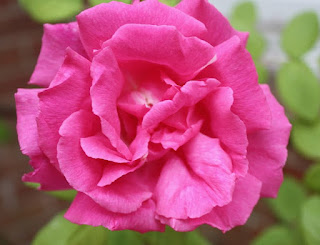
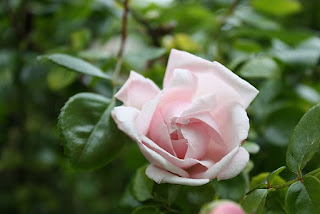


And you may have met Mrs Anthony Waterer and Cecile Brunner on other occasions recently.
Such elegance would not be out of place in the best establishments.

It is not hard to see why flowers like these have feminine names. Looking around the garden at the moment I realise I must still be going through that phase of loving pink that I thought I had out grown. I hardly ever wear it any more. But seeing that, of all the flowers mentioned in this post, only New Dawn was here when we moved in, I obviously have a passion for pink when it comes to planting flowers. After all, there are more that haven't been mentioned in this post, like the Grootendorst rose which is currently adorning the blog title.
They are all sumptuously gorgeous, especially this year. I know Savoy Hotel looks like a visit from the hotel inspector is overdue in this instance - it is a little wind damaged around the edges. The plant was a very thoughtful present last year but I had no chance to enjoy the flowers for the whole of the summer as the deer took every single bud just as it was about to open. I am just so thrilled to see it flower that I simply had to share it. Meanwhile 'Felicity and Perpetua' is covered in masses of little buds to the extent that the pergola tasked with supporting it is groaning with the weight. It is one of those 'moment of glory' roses - it will be magnificent, absolutely magnificent but not for very long.
Yes - it looks like being a good year for the roses - not to mention the poppies and the peonies.
Princess Victoria Louise.

Zephirine Drouhin

(New) Dawn
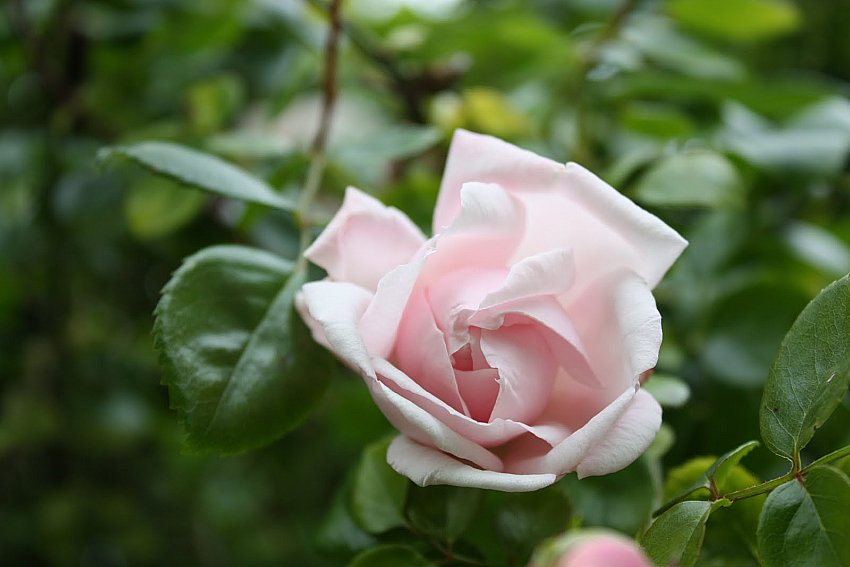
Felicity and Perpetua - (inseparable!)

And from the theatre, Sarah Bernhardt

and Sweet Juliet

And you may have met Mrs Anthony Waterer and Cecile Brunner on other occasions recently.
Such elegance would not be out of place in the best establishments.
Perhaps the Savoy Hotel?

It is not hard to see why flowers like these have feminine names. Looking around the garden at the moment I realise I must still be going through that phase of loving pink that I thought I had out grown. I hardly ever wear it any more. But seeing that, of all the flowers mentioned in this post, only New Dawn was here when we moved in, I obviously have a passion for pink when it comes to planting flowers. After all, there are more that haven't been mentioned in this post, like the Grootendorst rose which is currently adorning the blog title.
They are all sumptuously gorgeous, especially this year. I know Savoy Hotel looks like a visit from the hotel inspector is overdue in this instance - it is a little wind damaged around the edges. The plant was a very thoughtful present last year but I had no chance to enjoy the flowers for the whole of the summer as the deer took every single bud just as it was about to open. I am just so thrilled to see it flower that I simply had to share it. Meanwhile 'Felicity and Perpetua' is covered in masses of little buds to the extent that the pergola tasked with supporting it is groaning with the weight. It is one of those 'moment of glory' roses - it will be magnificent, absolutely magnificent but not for very long.
Yes - it looks like being a good year for the roses - not to mention the poppies and the peonies.
Monday, 30 May 2011
A Sampler for May

" A little sampler for the month of May
work'd when skies are warm and flowers are gay..."
it just had to be an invitation to take time to pick up needle and thread, right?
The book was Wessex Stitchery by Gay Eaton.
I had seen a chapter about Wessex Stitchery in an embroidery book I found in the library a couple of years ago. Being the inveterate dabbler that I am, I had tried some of the patterns and put a tiny sampler together. It became an inset for a birthday card. I had loved the intricacy of the patterns and found that with patience and intense concentration I had good results. That book went back to the libary, the card was posted and I moved on to other things. A couple of months ago, I found myself browsing Mary Corbet's site and found a review of Gay Eaton's book. There were enough shots of the pages to fire up my interest. Once again I just had to have a go. This time though, I focused on making samples of the illustrated stitches to keep as a guide once the book inevitably goes back to the library. (It seems to be out of print and is not so easy to get hold of.)
Excavating our cupboards in the quest of de-cluttering has unearthed the remnants of years of hobbies and pastimes so finding a piece of evenweave linen and a mass of different types of embroidery threads was no problem. I have been trying out the stitches using different thicknesses of threads and made the decision not to get too hooked on perfection. My eyesight is at the stage where I needed my glasses to read the pattern but found it easier to sew without them. There is a lot of counting of tiny threads at the beginning of each new pattern but as it grows and the counts can be memorised or worked out from the stitches already done, it begins to flow. There was a lot of ripping out and unpicking for some but I never gave up entirely - even though I may have abandoned the pattern for a day or two, I couldn't resist the urge to try one more time. Some of them where just so pretty they demanded to be learned.

These little blue 'forget-me-not' shapes either with or without their centres were very simple and effective.
And I liked the little diamond pattern worked in just a single strand.

There is nothing very complicated about the stitches themselves but it is the way in which these can be built up, overworking and infilling with multiple colours that would make much more ambitious projects fascinating to do. I wasn't going to try adding text even though that seems to be a necessary component of a sampler and of any Wessex Stitchery project. Lovely writing is is not my forte and calligraphy is an art I prefer to admire than to attempt. I was so pleased with this though, it has given me ideas for incorporating it into other projects.
So until the book has to be returned I will carry on sampling the patterns - maybe even some of the more complex ones. Yet another of the things that the longer day light hours were made for.
Friday, 27 May 2011
Clipping the Box
When we bought this house topiary came with the territory. We inherited five clipped box bushes years before their popularity underwent a revival. I came to the whole task of keeping these bushes trimmed as a complete novice apart from some practice in keeping a privet hedge tidy. I had the shears but not the know-how.

My mother was staying with us when we moved here and while we busied ourselves with carpets and curtains she began to take the garden in hand. She coaxed 5 distinctive shapes from what had been rather scruffy blobs and I began to see the quirky charm that these soft, green sculptures would bring to the garden. They were smaller then; I could probably have put my arms around each one and still touched finger tips. Twelve months (and another baby) later, I realized that it was now up to me, it was time to learn how to do topiary. No instructions, no demonstrations or workshops, I walked out across the lawn with shears in hand, asked the spirit of the garden to be forgiving and set about learning. Over thirty years later, this is what I probably should have known then.

My mother was staying with us when we moved here and while we busied ourselves with carpets and curtains she began to take the garden in hand. She coaxed 5 distinctive shapes from what had been rather scruffy blobs and I began to see the quirky charm that these soft, green sculptures would bring to the garden. They were smaller then; I could probably have put my arms around each one and still touched finger tips. Twelve months (and another baby) later, I realized that it was now up to me, it was time to learn how to do topiary. No instructions, no demonstrations or workshops, I walked out across the lawn with shears in hand, asked the spirit of the garden to be forgiving and set about learning. Over thirty years later, this is what I probably should have known then.
Sunday, 15 May 2011
Tea Rose
Just putting those two words together is enough to evoke rather nostalgic images, isn't it? You might expect to find them printed on the base of a patterned bone china tea cup or along the selvedge of a roll of chintz furnishing fabric. Something rather English, very 'roses round the cottage door' about the idea of tea roses.

It's not merely designers' whimsy as the term refers to a category of roses which has a history which starts in Asia and is founded on the fact that English people simultaneously developed a taste for tea and a passion for new and previously unknown plants and cultivars for their gardens.
"It seems that the early Tea roses as well as the Chinas arrived in ships of the East India Company, which were of course primarily concerned with the transporting of tea, but since a small part of their cargo yielded another new race of roses, it is possible that this, coupled with their unusual scent, led to the term 'Tea-scented rose'..."
From Beales, Peter 'Classic Roses'.
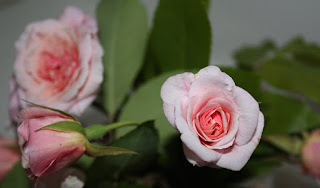
This rose is Cecile Brunner. As any rose aficionado would probably point out, this is not strictly speaking classed as a tea rose, it is however a China rose so its ancestry still shares something of the same romantic history. To me, it is the first rose I can remember and I loved it. By the time I was old enough to toddle around a garden, we were living on a farm hundreds of miles from where I was born. It had a house where no garden had been before. Initial priority was given to planting vegetables and establishing fruit trees, with a few annual flowers and hedges to protect everything from marauding rabbits and poultry. It was several years before my mother planted roses. In the meantime, like her, I got to enjoy them in her sister's and her mother's gardens during summer holidays. That Cecile Brunner shade of pale pink was my second most favourite colour then; it is such a charmingly dainty flower and although it there are a few thorns on the branches, the flower stems are smooth - all very child friendly. It is fragrant with a very distinctive, sweet, spicy note which if anything, has reminded me how powerfully memories can be evoked by our sense of smell.
The year after I planted this rose here in my English garden, I bent down to sniff the first flowers and I was stunned by how suddenly and vividly I was transported back miles (and decades). For a moment I was a four year old child standing in my aunt's garden holding a basket while she picked flowers. She chatted to me about the flowers and the posy she would make with them as a gift for a friend. She loved to make hand tied posies to give along with wishes for a happy birthday or a swift recovery. For me, she made dresses for my dolls and could snip out a string of paper dollies in an amazing instant. I remember though standing there in the garden agonized by the thought that it was very impolite to ask for presents but desperately wishing with all my heart that she would realise that one person who would just absolutely love to be the recipient of a posy of little pink roses was standing right beside her.

It's not merely designers' whimsy as the term refers to a category of roses which has a history which starts in Asia and is founded on the fact that English people simultaneously developed a taste for tea and a passion for new and previously unknown plants and cultivars for their gardens.
"It seems that the early Tea roses as well as the Chinas arrived in ships of the East India Company, which were of course primarily concerned with the transporting of tea, but since a small part of their cargo yielded another new race of roses, it is possible that this, coupled with their unusual scent, led to the term 'Tea-scented rose'..."
From Beales, Peter 'Classic Roses'.

This rose is Cecile Brunner. As any rose aficionado would probably point out, this is not strictly speaking classed as a tea rose, it is however a China rose so its ancestry still shares something of the same romantic history. To me, it is the first rose I can remember and I loved it. By the time I was old enough to toddle around a garden, we were living on a farm hundreds of miles from where I was born. It had a house where no garden had been before. Initial priority was given to planting vegetables and establishing fruit trees, with a few annual flowers and hedges to protect everything from marauding rabbits and poultry. It was several years before my mother planted roses. In the meantime, like her, I got to enjoy them in her sister's and her mother's gardens during summer holidays. That Cecile Brunner shade of pale pink was my second most favourite colour then; it is such a charmingly dainty flower and although it there are a few thorns on the branches, the flower stems are smooth - all very child friendly. It is fragrant with a very distinctive, sweet, spicy note which if anything, has reminded me how powerfully memories can be evoked by our sense of smell.
The year after I planted this rose here in my English garden, I bent down to sniff the first flowers and I was stunned by how suddenly and vividly I was transported back miles (and decades). For a moment I was a four year old child standing in my aunt's garden holding a basket while she picked flowers. She chatted to me about the flowers and the posy she would make with them as a gift for a friend. She loved to make hand tied posies to give along with wishes for a happy birthday or a swift recovery. For me, she made dresses for my dolls and could snip out a string of paper dollies in an amazing instant. I remember though standing there in the garden agonized by the thought that it was very impolite to ask for presents but desperately wishing with all my heart that she would realise that one person who would just absolutely love to be the recipient of a posy of little pink roses was standing right beside her.
Wednesday, 11 May 2011
Gardening with serendipity
In two weeks time I will be glued to the coverage of the Chelsea Flower Show. Who can fail to be amazed at the achievements of those who design the gardens and and even more so of all those who make those designs into gardens that look as if they have been in place for years? Forget all the hard landscaping, sculptural features and witty furnishings for outdoor living spaces; they are all just the trimmings for the really exciting stuff. The thing I really want to see is the way they combine colours and textures of the plants.
I guess this fascination is fuelled by the fact that their approach couldn't be more different from what happens in my garden when it comes to planting schemes. It goes something like this. Having decided that a plant I like would stand a reasonable chance of doing well in the soil and conditions our space can offer, I bring it home and find a spot for it that hopefully matches what the grower advised or nursery label suggests. Then I wait to see if it will be overlooked by the various browsers and grazers who live in or who visit our garden when hunger strikes. Basic survival is just the start of the process; often a move (or two) is needed to find that happy place where it can thrive. All of which means that the chances of it being next to anything I thought it might look rather wonderful with get slimmer and slimmer. What it does though is give a lot of scope for happy accidents and these do happen from time to time. Here are some I have been enjoying.

This rose, Mrs Anthony Waterer, has more cerise or magenta tones than this picture shows and I love it against the white and mauve of the wisteria. This year the rose has been very early and prolific - I believe 'flowering its hat off' is the appropriate Titchmarsh terminology. Could that be due to all the chopped up banana skins that have been reverentially laid at its feet over the last three years? Now according to Peter Beales catalogue, this is listed as a shrub which would only grow to 150cm. Great way to cover the bare legs at the base of the pergola and create a wall of blooms I was thinking as I planted it. This one, probably egged on by the climbers on either side of it, is more than twice that height. This is great as it means the flowers are up amongst the racemes of the wisteria, just where I think it looks especially lovely but I could never have planned that if I had followed all the expert advice.


I guess this fascination is fuelled by the fact that their approach couldn't be more different from what happens in my garden when it comes to planting schemes. It goes something like this. Having decided that a plant I like would stand a reasonable chance of doing well in the soil and conditions our space can offer, I bring it home and find a spot for it that hopefully matches what the grower advised or nursery label suggests. Then I wait to see if it will be overlooked by the various browsers and grazers who live in or who visit our garden when hunger strikes. Basic survival is just the start of the process; often a move (or two) is needed to find that happy place where it can thrive. All of which means that the chances of it being next to anything I thought it might look rather wonderful with get slimmer and slimmer. What it does though is give a lot of scope for happy accidents and these do happen from time to time. Here are some I have been enjoying.

This rose, Mrs Anthony Waterer, has more cerise or magenta tones than this picture shows and I love it against the white and mauve of the wisteria. This year the rose has been very early and prolific - I believe 'flowering its hat off' is the appropriate Titchmarsh terminology. Could that be due to all the chopped up banana skins that have been reverentially laid at its feet over the last three years? Now according to Peter Beales catalogue, this is listed as a shrub which would only grow to 150cm. Great way to cover the bare legs at the base of the pergola and create a wall of blooms I was thinking as I planted it. This one, probably egged on by the climbers on either side of it, is more than twice that height. This is great as it means the flowers are up amongst the racemes of the wisteria, just where I think it looks especially lovely but I could never have planned that if I had followed all the expert advice.
The brick red of the wallflower against the vibrant green euphorbia simply sings. The wallflowers have really gone over but I am hanging on to them for their last few days. This is the first year I have grown them. I picked up a bundle of the plants in a street market on a whim really. Lots of yellows, gold, peach and this lovely russety red. I will grow them again and with this colour combination logged here I will look for other ways to bring them together.

The centaurea or perennial cornflower was well established in this part of the garden when we came here and although I really hoped that the cotinus Royal Purple would grow up to make part of a shrub 'wall' for one of the rooms in the garden I am happy that for the time being it is staying low so that each year its new foliage sets off the verdi-gris leaves and royal blue flowers of its neighbour. Especially wonderful when the morning light shines through.
Mm, I can also see in the background that the clipped box may need its annual trim earlier too this year and of course I should be making sure that secateurs and shears are oiled and sharpened ready for the Chelsea Chop. Looking at gardens whether in the backyard or on television always seems to lead to jobs to be done, doesn't it? But as I work, I will watching and waiting for more instances of serendipity as the season moves along.
Subscribe to:
Posts (Atom)